
Surface Root Grinding in Durham, NC
Free quotes from independent local stump grinding companies. We connect Durham-area homeowners with independent local stump grinding and tree companies for free, no-obligation quotes. Get quotes to grind surface roots after a stump is gone, or to deal with roots under a lawn or walk.
Get a Free Quote Call (727) 300-6656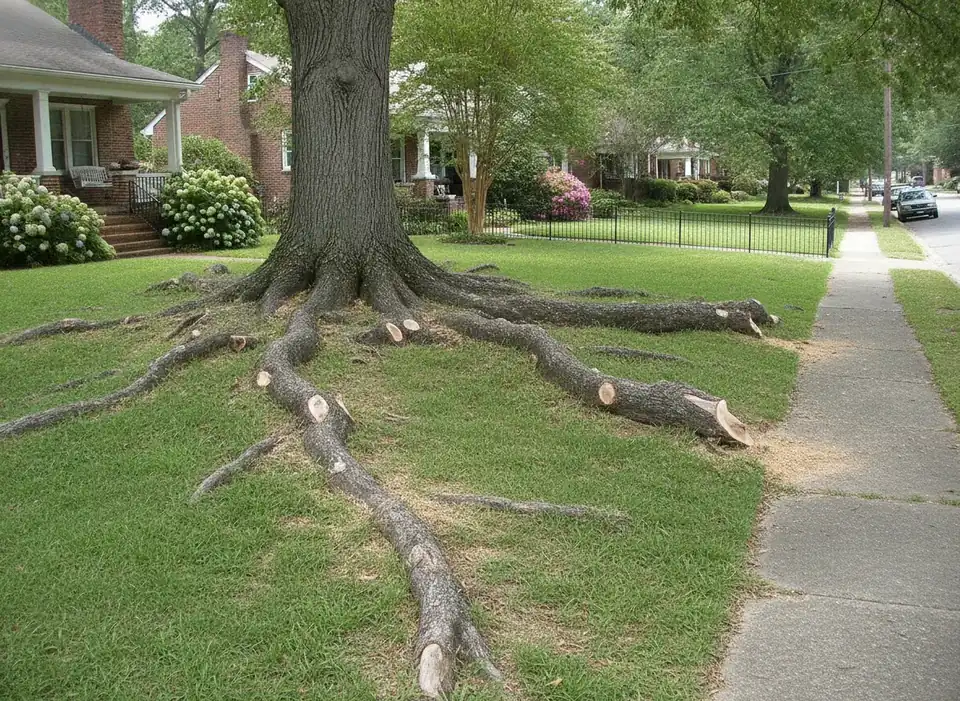
What root grinding is for
A standard stump grind removes the stump and the root flare just below it. It doesn’t follow the big lateral roots that run across the yard. Those roots can stick up above the grass, scalp the mower, trip people, and keep the area from leveling out when you reseed.
Surface root grinding follows those roots and chews them down below grade so the area can be filled and planted. It is usually priced by the hour.
We connect Durham-area homeowners with independent local stump grinding and tree companies for free, no-obligation quotes.
Willow oaks, maples and older Durham streets
In the 1930s Durham planted about 13,000 street trees, mostly willow oaks, according to a 2019 EPA article, and those trees are now reaching the end of their lives. As of 2014, the City’s Urban Forestry manager put the number of mature street willow oaks at around 8,000, with trees in historic neighborhoods 70 to 90 years old. Neighborhoods like Trinity Park, Forest Hills, Watts-Hillandale, West Durham and Hope Valley have many of these big oaks, and their roots often run under lawns, driveways and sidewalks.
NC State Extension describes willow oak as adaptable to clay soils with a fibrous root system. Red maple “makes a dense mat of surface roots,” and sweetgum and tulip poplar have shallow root systems. When one of these trees comes down, the roots are often the bigger cleanup job than the stump.
Roots near sidewalks and the street
Roots lifting a sidewalk or curb are a common Durham complaint. Before hiring anyone, work out whose tree it is. Trees in the City right-of-way, often the planting strip between sidewalk and street, belong to the City, and its Urban Forestry Division cares for them. Call Durham One Call (919-560-1200) and ask Urban Forestry first; it may be the City’s tree and the City’s job.
For a tree on your own lot, roots near paving, foundations and buried lines need care. A grinder can hit irrigation lines or invisible fence wire, so mark them. This is general information, not legal advice.
A caution about living trees
General caution: don’t grind the roots of a living tree without an arborist’s view first. Large roots anchor the tree and feed it. Cutting them can weaken the tree or make it unstable, and the damage may not show for years. Ask an ISA Certified Arborist, a voluntary credential you can verify at treesaregood.org, which roots can safely go.
Root grinding is simplest after the tree is already gone. If the tree is dead or declining and has to come down anyway, see tree removal; the stump and roots can be quoted at the same time.
Root grinding prices
| Item | Typical range |
|---|---|
| Surface root grinding | about $100–$200 per hour |
| One average stump, Durham area | about $150–$450 (Durham average about $327) |
| Minimum charge | about $100 |
| Chip haul-away | $2–$3 per inch, or about $80–$125 |
| Topsoil backfill per hole | about $50–$100; seed or sod $75–$200 |
Typical ranges from published cost guides (2025–2026) — estimates, not quotes. Your quote comes from the company you choose. See the full Durham stump grinding cost guide and calculator.
Ask how far out from the stump the roots will be ground, how deep, and whether the extra chips will be hauled away. Root grinding creates a lot of chips and soil; see stump grinding cleanup for what to do with them.
Grinding roots and NC 811
NC’s 811 law (G.S. 87-122) requires notice three full working days before digging; a ticket is valid 28 days. There is no minimum depth exemption, and mechanized grinding appears to fit the statute’s definition of excavation. The homeowner exemption (G.S. 87-124) covers only an owner digging on their own single-family lot, not a contractor for hire, so ask the company to confirm it will request a locate. 811 marks public lines only; flag private irrigation, lighting and pet-fence wires. This is general information, not legal advice.
Hiring checklist for root grinding
Whichever company you choose, check these before work starts:
- Liability insurance: ask for a certificate of general liability insurance in the company’s name.
- Workers’ comp: required in NC for businesses with three or more employees; check with the NC Industrial Commission’s coverage search.
- A written quote stating grinding depth, surface roots, chip cleanup or haul-away, and backfill.
- NC 811: ask who requests the locate and for the ticket number.
- Private lines: mark irrigation, invisible fence and landscape lighting yourself.
- Access: share gate width, slope and the distance from where a trailer can park.
- For tree removal: ask about ISA certification (a voluntary credential; verify at treesaregood.org) and crane or rigging needs.
Stump Grinding Durham does not grind stumps or remove trees; the independent company you choose quotes, schedules and does the work directly with you.
After the roots are ground
Ground roots leave a trench of chips. Have most of them raked out, fill with topsoil and reseed. Mushrooms that come up later are a sign buried roots are rotting, which NC State Extension says is harmless decay. Read what to do after stump grinding and how long a stump takes to rot.
Root grinding in nearby towns
Companies quoting through this site also work in:
Root grinding FAQ
How much does surface root grinding cost?
Published cost guides put surface root grinding at about $100–$200 per hour, since roots are priced by time rather than diameter. These are typical ranges, not quotes. Many companies add roots to a stump grinding job, so ask for the roots to be listed separately in the written quote, with how far out from the stump they will grind.
Can I grind the roots of a tree that is still alive?
Be careful. Grinding or cutting large roots of a living tree can harm its health and stability, and a tree that leans or fails later can be dangerous. As a general caution, don’t grind roots of a living tree without an arborist’s view first. An ISA Certified Arborist can say which roots can be removed and which should stay.
Who handles tree roots lifting a Durham sidewalk?
If the tree stands in the City right-of-way, often the strip between sidewalk and street, it may be a City tree. Call Durham One Call at 919-560-1200 and ask Urban Forestry before you hire anyone. Roots from a tree in your own yard are your responsibility, and an arborist can advise whether they can be cut safely.
Does stump grinding remove the roots?
Not all of them. A standard grind takes the stump and the root flare below it, typically 6–12 inches below grade. Lateral roots running out under the lawn stay in the ground and slowly rot. If ridges of roots show above the soil, ask for surface root grinding as a separate line in the quote.
Why do willow oak roots show above the lawn?
Willow oaks are the classic big street tree in older Durham neighborhoods, and NC State Extension describes them as having a fibrous root system and tolerating clay soils. Red maples make a dense mat of surface roots and sweetgums have shallow roots. Over decades, roots of these trees often rise to the surface, where mowers scalp them.
Got a stump in the way? Get free quotes.
Tell us how many stumps and where, and independent local grinders can send no-obligation quotes.