
How Deep Does Stump Grinding Go? A Durham Homeowner’s Guide
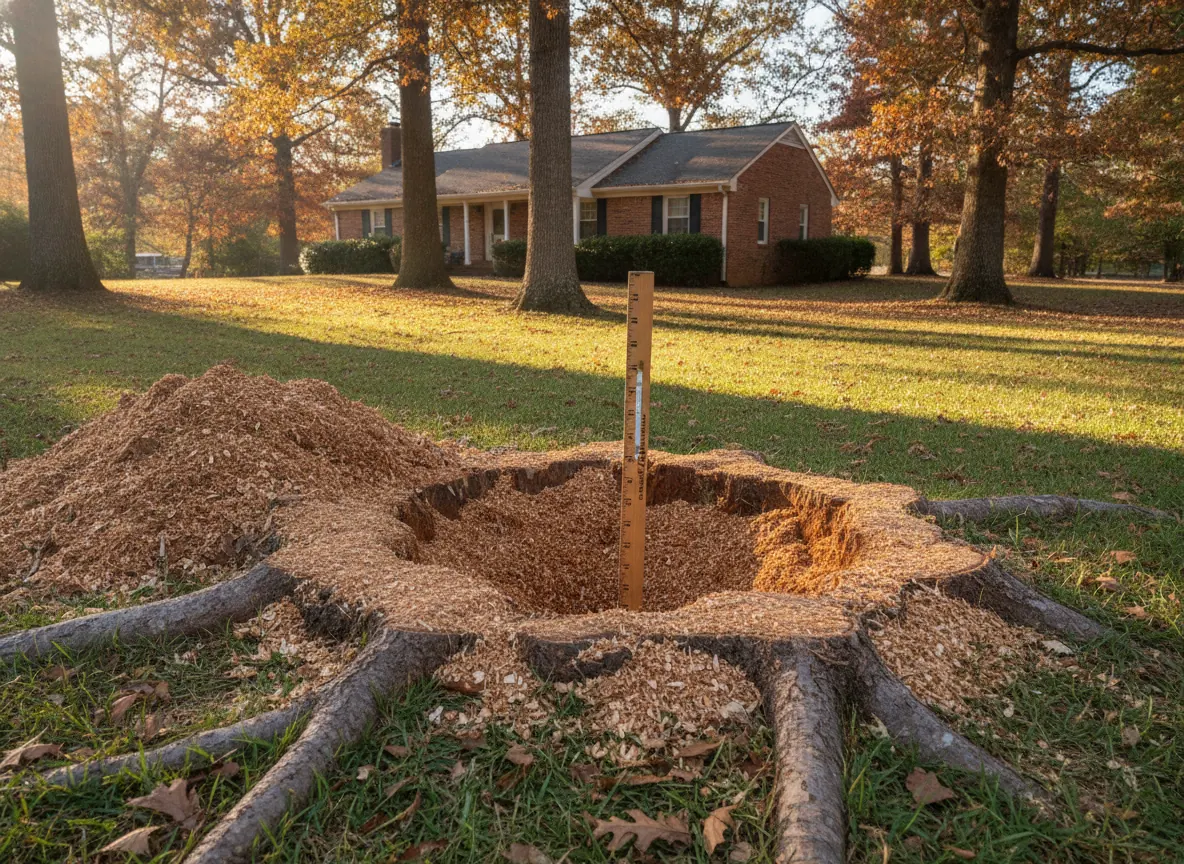
Typical residential stump grinding goes about 6 to 12 inches below grade. That’s usually deep enough to cover the spot with topsoil and grow grass over it. It isn’t deep enough to plant a new tree in the same place or to remove every root. Depths vary by company: one Durham stump grinding company’s page puts its usual depth at about 4 to 6 inches below grade, while NC State Extension’s guide to hiring tree care suggests confirming whether the job includes grinding the stump and surface roots to one foot below grade. The right depth depends on what you want in that spot next. Decide that first, then get the number in writing.
Why stump grinding depth varies from quote to quote
A grinder doesn’t pull the stump out. Its cutting wheel chips the wood away a little at a time and works down below the soil line, leaving the deeper roots in the ground to rot. How far down the operator goes is a choice, and deeper grinding takes more time and usually costs more.
Most Durham-area quotes start from stump diameter, typically $2 to $5 per inch, with a minimum charge around $100 (typical ranges from published cost guides (2025–2026), estimates, not quotes). Two quotes for the same stump can look far apart simply because one assumes 4 inches and the other 12. Ask each company what depth its price includes. The Durham stump grinding cost guide has the full price table and a calculator.
Matching grinding depth to what comes next
Grass or sod. The usual 6 to 12 inches works for most lawns. What matters more is what fills the hole. NC State Extension says woody material should not be mixed into soil where grass or other plants are being established, and grass has trouble growing through thick woody material. So have most of the grindings raked out or hauled off, then fill the hole with topsoil before seeding. Backfill typically runs about $50 to $100 per hole, plus $75 to $200 for seed or sod. The stump grinding cleanup and backfill page covers those options.
A new tree in the same spot. Old roots stay below a standard grind. If you want to replant there, ask for a deeper grind or more root removal, or compare it with full stump removal, which digs the stump and main roots out (typically about $175 to $520).
A patio, shed pad or addition. Tell the company before it quotes. Ask for a deeper grind if you’ll build there, and get the depth written down.
A garden bed. A standard grind is usually fine. NC State Extension says wood chips can be used uncomposted as mulch around the bases of trees and shrubs, so some of the grindings can go on top of the bed, not into the soil.
Surface roots are a separate depth question
The depth on a quote usually describes the stump itself. Big surface roots running across a lawn, like the willow oak roots common in older Durham neighborhoods, are a separate job. Surface root grinding is typically priced by the hour, about $100 to $200. If roots are part of why you want the stump gone, say so and ask how far out from the stump they’ll be ground and how deep. See root grinding in Durham for more.
If the stump or roots sit in the strip between the sidewalk and the street, check before hiring anyone. It may be a City tree in the right-of-way, which falls under Durham’s Urban Forestry. Call Durham One Call at 919-560-1200 and ask.
Durham clay, settling and mushrooms after a deep grind
The grind isn’t the last step underground. The roots left below the cut keep decaying, and the fill above them settles. Parts of Durham sit on Triassic-basin soils such as the White Store and Creedmoor series, which are high shrink-swell clays. Wherever you are, expect the fill to sink a little as the chips and roots break down, and top it up with soil after a few months before reseeding bare patches.
Mushrooms may come up over the old root zone. NC State Extension describes lawn mushrooms as saprophytes that “decompose dead organic matter like buried wood, old tree roots, or thatch.” They mean the roots are rotting, not that the lawn is diseased. NC State also notes that removing buried woody debris before planting turf can keep fairy rings from starting. That’s one more reason to take out most of the chips before you seed.
Grinding depth and NC 811
A shallow grind doesn’t get you out of the utility locate. North Carolina’s 811 law sets no minimum depth for excavation. The only shallow-depth exemption is tilling less than 12 inches deep for farming or gardening, and a grinder cuts rather than tills. Mechanized grinding appears to fit the law’s definition of excavation, and the homeowner exemption covers owners doing their own work, not a company hired to do it. Ask the company to confirm it will file a locate request at least three full working days before grinding. 811 marks public lines only, so point out private ones yourself: irrigation, invisible dog fence, landscape lighting, and power or gas run to a shed or pool. Our 811 guide for stump grinding explains the rules. This is general information, not legal advice.
When going deeper won’t fix the problem
Some trees come back from their roots no matter how deep the stump is ground. NC State Extension calls tree-of-heaven “very invasive and difficult to eradicate,” and a Buncombe County Extension article warns that cutting it can produce many suckers, some more than 25 feet away. Black locust and mimosa also resprout. For these, grinding alone won’t stop the sprouts; they need a herbicide plan. If a company will treat the stump for you, ask for its NC commercial pesticide applicator license number, which the state requires for applying herbicide on someone else’s property for pay.
What to write on the quote
- Grinding depth below grade (for example, “12 inches”)
- Whether surface roots are included, how far out and how deep
- Chips raked into the hole, hauled away or left in a pile
- Topsoil backfill and seed or sod, or neither
- Who files the NC 811 locate request
Once you know the depth you need, you can compare quotes fairly. Request free quotes from independent local stump grinding companies and tell them your plan for the spot. You can also read what to do after stump grinding, or see how it works on the newer, pine-heavy lots in Apex.
Stump grinding depth: quick answers
Is 6 inches deep enough for stump grinding?
For a lawn, usually yes. Typical residential grinding goes about 6 to 12 inches below grade, which leaves room for topsoil and grass seed. If you plan to plant a tree there or build over the spot, ask for a deeper grind or more root removal, and get the depth written into the quote.
Does deeper stump grinding cost more?
Usually. Deeper grinding takes more time, and most Durham-area quotes start from stump diameter, typically $2 to $5 per inch with a minimum around $100. Ask each company what depth its price assumes and what going deeper would add, so you can compare quotes fairly.
How deep should a stump be ground to plant a new tree?
Deeper than the usual 6 to 12 inches. Old roots stay in the ground below a standard grind, so ask the company for a deeper grind or more root removal in that spot, or ask about full stump removal. Get the agreed depth in writing before the work starts.
Got a stump in the way? Get free quotes.
Tell us how many stumps and where, and independent local grinders can send no-obligation quotes.